Wednesday, July 30, 2008

The Gravedigger's Daughter, by Joyce Carol Oates


The gravedigger's daughter takes on several names over her lifetime in her attempts to escape her past. The effort is a strain that she is willing to bear until near the end, when she tries to recover a bit of what was lost.

Rebecca Schwart grows up in a cemetery, the daughter of a European immigrant who had to escape Germany to save his family's life. Rebecca is born on the ship in the New York harbor, the first of the family to become an American citizen. The event brings additional hardship to the small family, however, as her father Jacob can only find work digging graves for miserly wages. His employers give him a run-down stone house on the cemetery grounds to live in and seem to believe they are doing him a favor.

While Jacob is careful to express his gratitude and subservience to his employers, inside he seethes with resentment. In Europe he had held respectable jobs and was able to provide well for his family. He tells his wife Anna that he will get them out of there within a year, that they will save and better themselves. To that end he starts a private savings account and carefully puts away bits of his wages regularly.

Because they are no longer in the "old country" Jacob insists that Anna speak only English. She is embarrassed at her speech and does not make friends easily. As time goes on she becomes more and more insulated from the outside world and cares less and less about her house and her family.

There is one time when she regains her hope and excitement: when her sister's family is expected to arrive from Europe and to live with them. Rebecca joins in the excitement and fantasizes about the "new sister" she hopes will share her bed.

Rebecca determines to learn her way out of the graveyard. She suffers from the verbal and physical abuse of her classmates, who look down on her torn and dirty clothes and laugh at her name.

It is perhaps not surprising that a difficult childhood like this one might make a woman strong, untrusting, and wary of others. Yet yearning for intimacy. And so it does with Rebecca. As an adult she makes her way determinedly out of the shade of her childhood. This determination leads to some decisions that later cause further pain and isolate her even more.

The events in the book take place over many years, and the story is developed by several steps into different periods of Rebecca's life and the life of her son. The characters in this story are beautifully constructed. The voices are true, and reflect almost too well the time and place and circumstances. There is no holding back, no softening of the edges. While we may root for Rebecca we don't always love her. We certainly don't love some of the men in her life. Mostly, though, we can't help but feel her pain in wanting a past she could not have.

Tuesday, July 22, 2008

The China Study, by T. Colin Campbell


The title and subtitle are misleading. Although the so-called "China Study" forms the basis for the conclusions in this book, the book goes well beyond that one study. This is also not a diet book. This book is about the connection between food and disease, more specifically about how animal protein affects our health negatively. The subtitle does not overstate the case when it refers to the book's research as having "startling implications".

Campbell has been on the forefront of thought and research about nutrition since the start of his career. His origin in a farm family, where he learned that meat and more meat is good for everyone and where drinking milk was a way of life, makes his position in this book all the more remarkable. In spite of his long-held beliefs in the health value of animal protein he kept his eyes and mind open and discovered and conducted study after study that linked animal-food diets with cancer, heart disease, and a large number of other diseases. When he naively brought his discoveries to the institutions where he worked, hoping for the go-ahead to do more and to get the word out, he was quietly shoved aside.

This book, therefore, goes beyond telling us the results, telling us to eat a plant-based diet to avoid or help stabilize heart disease, diabetes, cancer, auto-immune diseases, and more. In it we learn of many of the specific studies that convinced him that eating primarily animal proteins is bad for your health. Not just bad for heart or diabetes patients, but bad for everyone. He explains the effects of genes, how some diseases (auto-immune) cause the body to attack itself, and even describes the specific mechanism that causes our bodies to use animal proteins in a way that can harm us.

Campbell also explains the political and medical climate. We've heard it before and here it is again: Industry controls government institutions as well as educational and medical institutions. Industry has the money and uses it wisely to change results and recommendations, to water down any suggestion that the standard American diet is not what it should be.

It isn't a weight-loss book, but if you follow it and you have a weight problem your problem could be solved. As I am fat myself I know there are other forces that make it very difficult for us, cravings that are far stronger than unfat people have ever felt. There is no doubt, in any case, that following this "diet" - which is a simple list of what to eat and what not, without any portion sizes (just "eat as much as you want" and "eat less" recommendations) - will make anyone healthier.

The claims made in this book are radical. Make no mistake. If followed, the American diet would make a huge swing and animal agriculture would be on its way out. Yet it isn't nearly as difficult to follow these recommendations as many think. One of the primary reasons doctors don't like to ask their patients to make radical changes is that they believe their patients will give up, that it will be too hard. But based on my own experience as well as some cited in the book, going in the plant direction opens up whole worlds that meat-eaters rarely explore. Instead of reducing our choices, this change increases them. It is also a way to never be hungry again. Diets that make people hungry may seem good for the soul but they aren't good for the body.

For proof of these claims that is as definitive as it is possible to get, read the book. It will probably change your life and it may save it.

Saturday, July 5, 2008

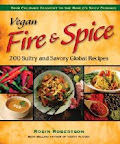
Vegan Fire and Spice, by Robin Robertson

Robin Robertson’s new cookbook, Vegan Fire and Spice, is garnering rave reviews from all over. And with good reason. The dishes are easy to make, use commonly-available fresh ingredients, and offer a splendid array of tastes.

Many of us who have been vegetarian or vegan for a while reach a point when we want to do more than order Indian take-out. We want to make Indian take-out. Not to mention African, Caribbean, South American, and more. We want to shake up our own kitchens by bringing in different techniques and flavors. This book promises to give us the means. The book is a reworking of Robertson’s Some Like it Hot, with all recipes veganized and 25 additional recipes added. It is also the first to be published by Robertson’s new enterprise, Vegan Heritage Press. I recently tested several of the recipes from different parts of the book and all were successful. Some made it to a coveted place on my sure-to-make-again list because they are simply too good.

The cookbook is divided into sections, each section a geographical region that is known for spicy and hot dishes. When you open to that section there is a list of recipes, categorized by “appetizers”, “soups”, and so on. The recipes, then, are not listed in their entirety in one place. The index is complete, however, so if you are looking for a specific recipe and don’t remember where it comes from you will find it there. It makes sense to look within a region for a menu of dishes rather than take a chance on mixing cultures, picking one from Italy and another from China, for example. For this reason I find the arrangement agreeable.

Each recipe is on its own page. No sharing. I prefer this standard, as it’s easier to find the recipe and to follow it.

There are no pictures, other than on the cover. I love pictures but I appreciate the economies of leaving them out. It adds to the adventure, too.

The recipes are easy to make. I admit to being an occasionally ambitious cook, happy at times to create complex dishes that take specialized skills. Most of the time, though, I prefer to put together meals quickly and easily and know they will turn out right even when some parts go wrong or I have to substitute some ingredients. Forgivable recipes, I call them, that’s what I look for.

From my experiments with Fire and Spice, I believe that’s what we have here: forgivable recipes. When I made the Senegalese soup (p. 119) the first time I got distracted and burned the mix of onions and celery. I didn’t want to start over so I scraped out the less-burned parts and dumped them in another pan and continued on. I suspect the soup would have been better if I’d had the full contingent of onion and celery and none of it was burned but it was nonetheless delicious. When I made the vegetable pakoras I didn’t chop the cauliflower enough, and I made the mistake of throwing in the cauliflower before I had the flour and water mixed. But I soldiered on and although the pakoras were not beautiful they were tasty indeed. Way too tasty, considering I made a full batch and there was only the one of me in the house.

Some of the mistakes I made came about because the recipes are not always as specific as they could be. One recipe calls for two Granny Smith Apples, another for a head of cauliflower, another for one or two yams or sweet potatoes. Not all of these recipes specify the size of these vegetables or an alternative measure, like weight or number of cups. In my experience some vegetables and fruits can vary dramatically in size. Sometimes the directions lack a little: the pakora recipe says to mix enough water into the flour mix to “make a batter”. But how thick?

And sometimes the timing is off. When I made the Chickpea and Green Bean Curry (p. 158) I had to make my dinner guest wait because it took much longer for the green beans to cook than estimated. My beans were fresh and cut according to directions and I think they were typical of what you would find in a grocery vegetable section, so I’d suspect my experience would be typical. Most of the time I did find the time estimates within the recipes to be accurate, however. What I would have appreciated, though, would have been estimates of time to make the entire dish.

Minor gripes. Most of the recipes do list ingredients by weight or cups and most of the directions are clear and unmistakable in intent.

The recipes call for fresh vegetables and fruits most of the time. Occasionally they require canned diced tomatoes or canned beans, but most of the ingredients are fresh, as they would be in their native countries. This means you do need to do a little preparation. The good news is that most of this preparation can be done ahead of time, as it would be in a restaurant if you were the sous chef (according to Wikipedia the more correct term may be commis chef, one who prepares vegetables unaided). The better news is that this is basic prep, nothing fancy, nothing beyond you.

Should you be new to kitchen equipment or preparation, though, there is a helpful section at the beginning of the book that tells you all you will need to know. There is also a section on the nature of spices, chiles, and other “exotic” ingredients. I inserted the quotation marks because seitan is about as exotic as they get here, meaning you should be able to find most of the ingredients, or reasonable substitutions, in any well-stocked grocery store, and the few remaining can be obtained at a natural foods store or even online.

Using fresh ingredients means the dishes will taste as good as they should. It’s worth using the freshest you can find because you’ll notice the difference.

Even though I see this book as the guide to an adventure the seasoned vegan is going to want to take, a brand new vegan cook can confidently prepare these delicious dishes and be proud.


Sunday, May 4, 2008

Heart-Shaped Box, by Joe Hill


Books that focus on the supernatural rarely attract me. Horror stories rarely attract me. Yet now and then I will find myself reading a book that fits in these categories and for some reason will like it.

Such is the case here. Jude Coyne, aqing heavy metal star, is living with "Georgia", a woman almost thirty years younger than he is. He calls her Georgia because that's where she's from. Her real name is Mary Beth. His insistence on giving meaningless names to his lovers is indicative of the distance he prefers to maintain in all relationships.

Jude is hard to shock. In fact, he collects bizarre objects as part of his efforts to build an impression of himself that matches his rock star image. And so it is that he is hooked when he reads of an online auction of a ghost. He jumps to the "buy it now" option, purchasing the suit the ghost comes in for $1,000.

What seemed a bit of a blast turns into a nightmare. The suit really does have a ghost attached, and that ghost is out to get him. Jude, though, is not so easily got. He resists one attack after another, gaining severe injuries in the process, and while he initially tries to send Mary Beth away - to protect her - she insists on hanging in and suffers greatly for that decision.

What kept me going was my attachment to Jude and Mary Beth, as they struggle not only to rid themselves of this evil presence but to discover in each other strengths they did not know they had.

I wouldn't say this book changed my life or changed my view of the world or a part of it, but it is strangely and unsentimentally heartwarming.

Monday, April 28, 2008

Eleni, by Nicholas Gage

An extraordinary blend of investigative reporting and imagination, originally printed in 1983. Nicholas Gage, who emigrated at the age of nine to America from Greece in 1949, was haunted by his mother's death. His mother, Eleni, was tried and executed in his little mountain village in 1948, by communist guerrillas, who controlled the village during the civil war there.

Gage wanted to know who was really responsible for his mother's death. True to his heritage, as an adult he set out to revenge her death, but his background in investigative journalism led him to seek out the truth first.

In this massive tale, over 600 pages in the cheap paperback edition I bought, Gage begins at the beginning and relentlessly takes us on every road, into every conversation, through the relatively good times and into the horrific, that holds a part of his mother. He sketches her early years and marriage, giving us a glimpse of her husband Christo, who sought his fortune in the United States, returning periodically to be with his wife but who believed it better to keep her in Greece, living the "old ways" while he lived the new. From 1940, when the communist and fascist guerrilla groups were gaining ground in Greece, until her death in 1948, Eleni lived a life of increasing hardship. She had come from a family of privilege and her husband had sent her money for her support while he was gone, but in 1940 the mail was cut off and she no longer had any support or any word from him.

Life in the mountain village of Lia was hardly a cakewalk in the best of times. The culture demanded that women follow strict standards of dress and behavior, much as fundamentalist Muslim women do now. Women were raised to obey the men in their lives, to make no decisions on their own.

It was just this fact that eventually led to Eleni's death. When she first had a chance to get out of Lia she did not take it because her husband, in his last letter to her, had said the guerrillas were their friends and they would not hurt her. She could not disobey him. Later, though, she saw that her fate and that of her children demanded that she make a different decision.

She engineered an escape, revealing a raw courage that belied her cultural background. Other women who joined the escape band were less secure, unsure of what to do or how to manage without direct orders from men. Eleni was unable to join the group ultimately, but gave her children directions to avoid detection by guerrillas when they slipped away. The escape shocked the village and the guerrilla government decided somebody had to pay.

Gage doesn't spare many details. His story reads like fiction, with characters, words, and thoughts fleshed out. Intermittently he inserts first-person narratives, reminding us that it isn't fiction. The blend reminds me a bit of Truman Capote's In Cold Blood and Mailer's The Executioner's Song, but Gage has a more personal relationship with his main character and this relationship is what drives the tale. The quality of the re-creation isn't as literary as the other two works but it's far beyond hackwork.

While the story is clearly about Eleni it also gives us a good picture of life in the mountain villages in Greece at the time. It also helped me to see how a civil war like this one can pit neighbor against neighbor, with horrifying consequences. Yet at the heart of it I was surprised to find that most of the villagers did not succumb to greed when it would have been easy, did not choose to speak against others to gain privileges for themselves. Certainly some did these things, but their characters had been evident before the guerrillas moved in. It is easy to become irritated at the superstitions, the cultural norms, the ignorance at the heart of village life. Yet the innate strength of many of the same people is impressive. Perhaps living in a village where everyone knows everyone else's secrets does make for stronger bonds.

Knowing the end ahead of time made the reading hard-going for me at times. I had nightmares two nights in a row, about executions. I couldn't wait to get through the details, details, details, and past the death itself. When it came it didn't hit me like a fist in my stomach as I had anticipated. I was relieved. An extra treat for me, having made it that far, was the wrapping up, the resolution of Gage's hunt for revenge. Riveting reading, all the way through.

Monday, April 14, 2008

How Doctors Think, by Jerome Groopman, M.D.


A terrific book. Groopman takes on the task of figuring out how doctors make decisions about treatment. He finds that the majority of medical mistakes come from certain types of thinking patterns that doctors fall into. He offers simple suggestions to both doctor and patient to help the doctors break out of these patterns in particular cases.

Patients and doctors can benefit most by understanding the "three As", as they were termed by one reader:

  • anchoring
  • attribution
  • availability

"Anchoring" is seizing on a set of symptoms, making a snap diagnosis and not looking further

"Attribution" is making assumptions about a patient because of certain patient attributes - old, young, complainer, whatever. In an episode of House the patient was a hugely obese man who insisted that the doctors look past his weight for what was wrong with him. Turns out he was right; the diagnosis was bad but had nothing to do with his weight.

"Availability" is the tendency to remember, in a flash, similar cases and assign the present case to the same group. For example, if the doctor has been treating a number of people with abdominal pains and they all had acid reflux he might jump to that assumption in a similar case because the diagnosis is "available" - frequently used, easy to call on.

I am sure I haven't described these as well as I could. What is critical for patients is to ask some meaningful questions when they feel the diagnosis may not be right for some reason. Here are the questions Dr. Groopman suggests:

"What else could it be?" - this question can break the physician away from a snap diagnosis.

"Could two things be going on at once?" In other words, might there be two problems instead of one?

"Is there anything in my history or the tests that seem to be at odds with the diagnosis?" Sometimes doctors see symptoms that "don't fit" but simply label them "atypical". This question brings those symptoms to the front.

I want to give a copy of this book to the doctor I have seen a few times, the doctor I am starting to consider my primary physician. I think all doctors should read it, and in the case of my doctor I suspect he actually would. It's a great resource, written compassionately and clearly, that does not condemn doctors; instead it can help them be better than they are.

Sunday, April 13, 2008

The Glass Castle, by Jeannette Walls


A memoir about a family living on the edge, deliberately.

Walls is born to parents who are highly intelligent and creative but whose own presumably (and suggested) dark pasts make them both junkies for excitement and change. Thus they live from hand to mouth, rarely staying in one place longer than a couple of months, for the early part of Jeanette's childhood. Jeanette's father is an alcoholic who isn't able to keep a job but who has big dreams as well as big smarts. He manages to keep their various vehicles alive one way or another, devises engineering feats where necessary, teaches his children about the stars, about physics, about math, proudly pushes them (literally) into the water where they must sink or swim.

Her mother wraps herself into her own creative ventures, painting, writing, sketching, and is usually ready when the family has to "skedaddle" in the middle of the night. Neither parent worries about the health of their children, living by the maxim that what doesn't kill you makes you stronger. On this front it appears that her mother is the tougher of the two in some respects.

By the time Jeanette and her family move into Welch, Virginia, her father's childhood home, she certainly can take care of herself. She worships her father yet recognizes that he has failed her time and again. All of the children - Lori, Jeanette, Brian, and Maureen - somehow manage to find food, stay clothed, and go to school, and even excel. They don't make friends easily, finding that even in this "okie" territory they are outcasts, dirtier, skinnier, and tougher than the rest.

It's a memoir of a tough life that at times seemed wondrous to Jeanette. Being given a star for her birthday. Sleeping in a cardboard appliance box. Being encouraged to challenge life rather than be challenged by it. Thus it is more than a sad tale of children of an alcoholic, even though those of us who share that distinction are going to recognize some of the responses. It is more a tale of resilience and hope and ultimately simply acceptance.